
This article appeared in The Daily Texan on March 9, 2016
Refugees from all over the world flee their home countries, seeking reprieve in the United States. Once they arrive, they must overcome language, cultural and economic barriers — all of which UT students are helping break down.
Interfaith Action of Central Texas, or iACT, is a local organization that teaches English as a second language courses for adult refugees. Last semester, they developed a mentorship program in which college-age students meet with high school refugees once a week to help them with their English, schoolwork and cultural adaptation.
International relations junior Missy Glasenapp, an iACT intern, said the program is important because the refugees are often forced to leave behind their families and communities, lacking similar support systems in America.
“Someone from the country that’s nice and isn’t judgmental and is willing to spend some time helping them, I think that makes a huge difference for [the refugees,]” Glasenapp said.
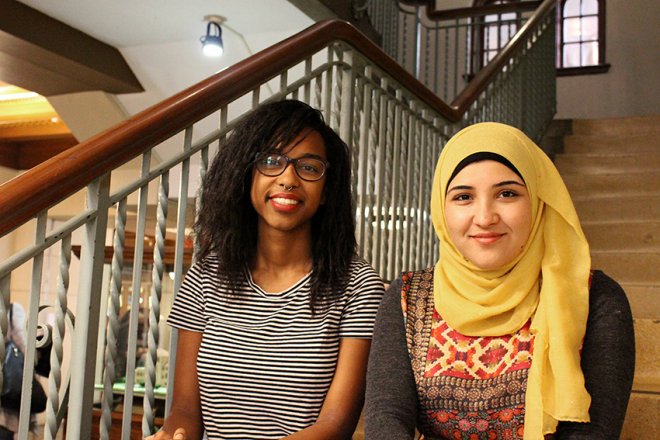
Jude Mattar, a sophomore at Austin Community College, mentors Maryam, a 16-year-old girl from Afghanistan. Mattar, who was born in Jordan, said she relates to the isolation Maryam sometimes feels transitioning from her tightly knit community in Afghanistan, to a more independent, expansive American society.
Mattar said Maryam sometimes talks about the chaos and violence she suffered in her home country but now focuses more on her future and is trying to move past
those experiences.
“People have this idea that if you’re helping someone, you’re superior to them in some way,” Mattar said. “I completely hate that because [the refugees] weren’t inferior in any way — they were fine on their own. If anything, I gained more than they gained.”
During Mattar’s sessions with Maryam, they discuss cultural differences, such as the time commitment certain jobs take up and how marriages work in the U.S.
“They’re labeled as refugees, so you start viewing them differently,” Mattar said. “It’s projects like these that remind us of the humanity of it all — they’re not just issues. We can’t just disconnect from them. They’re in our society, and they’re a part of us.”
Glasenapp mentors two elementary school boys from Iran and said she hopes to use her developing Arabic skills to help their families. Because of chaos in the refugees’ home countries, their education is often interrupted or inadequate, and sometimes, for example, children that are 11-years-old may have only been to one or two years of school.
“I started learning [Arabic] because I wanted to be more connected with more people and more cultures,” Glasenapp said. “I think that’s the perfect opportunity — people that are here and need help.”
Danielle D’aguilar, a Plan II, Middle Eastern studies and Hindi Urdu junior, also interns at iACT. As a mentor facilitator, she matched 15 refugee families with mentors in the fall and now ensures their needs are satisfied. Her goal is to improve the students’ ESL and math scores so they can graduate high school.
This goal is made more difficult because students must be enrolled in ESL courses, often taught in Spanish. They are also required to learn an additional foreign language and pass standardized tests.
Mattar’s mentee, Maryam, is planning to graduate early this spring and has already been accepted by the University of Texas at San Antonio. Although not all of the refugees have reached this success, D’aguilar said Maryam worked hard to learn English before she came to America, speaking with her father and listening to broadcasts of President Obama on the radio.
“The main goal is to have these students graduate or at least get a GED — that’s what we consider a success,” D’aguilar said. “Maryam going to UTSA and wanting to be a civil engineer — that, right there, is why we’re doing this.”


